

Table of Contents
- What Is Aluminum Wiring and Why It Was Used
- The Fire Hazard: Why Aluminum Wiring Is Dangerous
- How to Identify Aluminum Wiring in Your Home
- Aluminum vs. Copper Wiring: Key Differences
- CO/ALR Devices: A Partial Solution
- Remediation Options and Cost to Rewire a House
- Protecting Your Home: Next Steps
Last Updated: August 16, 2026
What Is Aluminum Wiring and Why It Was Used
Aluminum wiring is electrical conductor made from aluminum metal rather than copper, used primarily in residential electrical systems installed between the mid-1960s and early 1980s. During this period, aluminum became popular because it was significantly cheaper than copper and more abundant. When copper prices spiked in the 1970s, builders increasingly switched to aluminum as a cost-saving alternative for branch circuits (the wiring that runs from your electrical panel to outlets, switches, and fixtures throughout your home).
Aluminum has excellent electrical conductivity relative to its cost, and engineers believed it would perform identically to copper. However, what seemed practical at the time turned out to have serious safety implications that weren’t fully understood until fire incidents and electrical failures revealed the material’s fundamental weaknesses in home electrical systems.
If your home was built during this era, there’s a reasonable chance your branch circuit wiring contains aluminum. Homes built after the early 1980s typically use copper wiring exclusively, as the dangers became widely recognized and building codes shifted to require safer materials.
Aluminum wiring was primarily used for branch circuits (the smaller wires running to outlets and switches), not for the main service entrance. This distinction matters because the dangerous parts are distributed throughout the walls where you can’t see them.
The Fire Hazard: Why Aluminum Wiring Is Dangerous
The dangers of aluminum wiring stem from fundamental differences between aluminum and copper as electrical conductors. When electrical current flows through any wire, it generates heat. Copper handles thermal expansion and contraction reliably over decades. Aluminum expands and contracts at roughly 40% more than copper for the same temperature change. This constant cycling causes connections to loosen over time, creating gaps where electrical resistance increases dramatically.
As resistance builds at a connection point, heat generation accelerates. The wire begins to overheat at the terminal screw or connection point, eventually reaching temperatures high enough to ignite surrounding insulation, drywall, or wooden framing.
Oxidation compounds this problem significantly. When aluminum is exposed to air, it forms an aluminum oxide layer, a thin whitish coating. Unlike copper oxide, aluminum oxide is an electrical insulator. This forces electrical current to jump across microscopic gaps in the oxide coating, creating arcing and intense localized heat. Over months and years, this arcing weakens both the wire and the terminal connection, accelerating the loosening process and increasing fire risk.
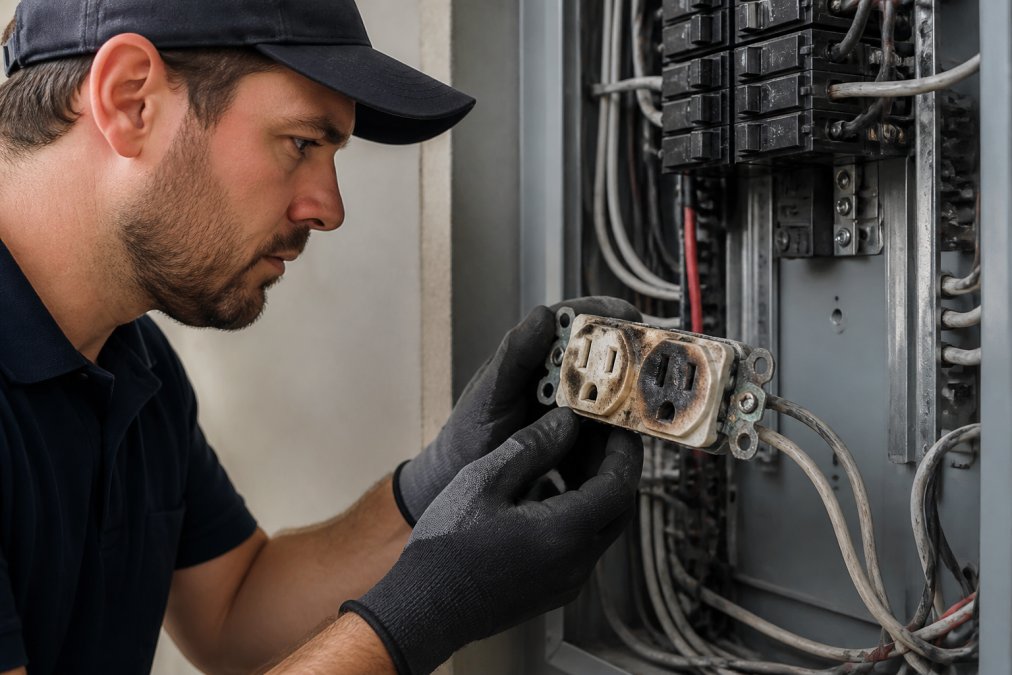
The Consumer Product Safety Commission (CPSC) has documented numerous house fires attributed to aluminum wiring failures, most occurring at connection points, outlets, switches, light fixtures, and the breaker panel. Fires often start inside walls where they can smolder undetected before breaking through to visible areas.
Aluminum wiring fires don’t always trigger circuit breakers immediately. The breaker may not trip until the current surge becomes extreme, which can take minutes or longer. By that time, the fire may already be spreading inside the wall cavity where you cannot see it or extinguish it.
The risk increases with electrical load and frequency of use. Circuits that carry higher amperage or are used frequently (like kitchen outlets or living room lighting) heat up more and cycle on and off more often, accelerating degradation. A rarely-used outlet might remain stable for decades, while a frequently-used one could fail within 10-15 years.
How to Identify Aluminum Wiring in Your Home
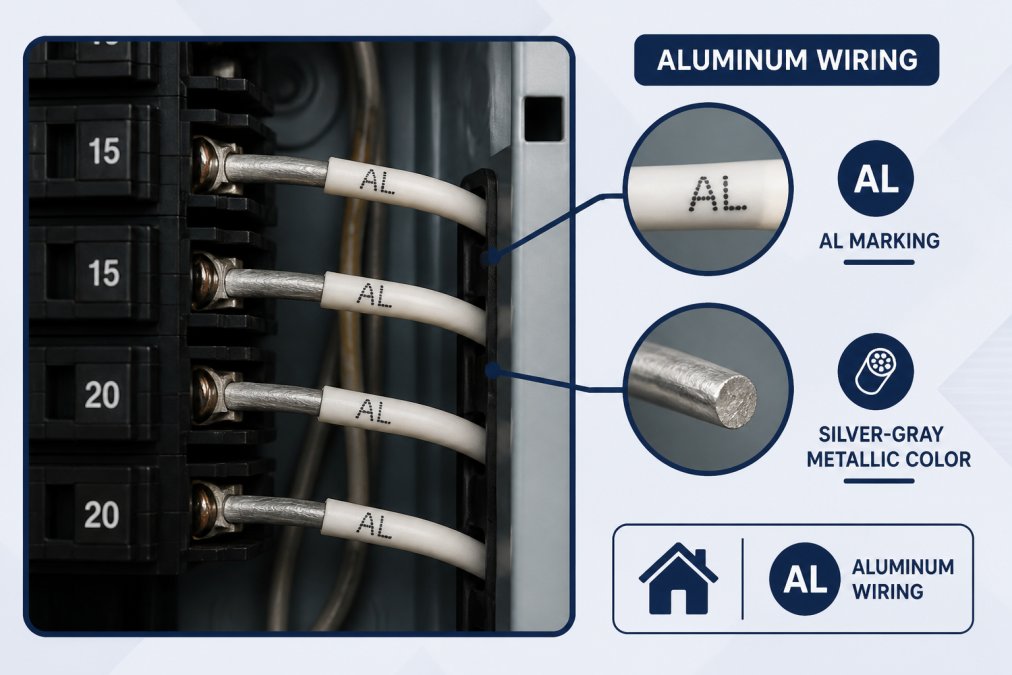
Identifying aluminum wiring requires a visual inspection of your electrical panel and accessible wiring. Open your electrical panel (or have a licensed electrician do it) and look at the wires connected to the circuit breakers. Aluminum wire has a distinctive silver-gray color, noticeably lighter than copper wire, which is reddish or brownish.
The wire insulation may also have markings indicating the material. Look for labels that say "AL" or "Aluminum." Some aluminum wiring is marked with "ALUM" printed along the insulation. Copper wiring typically shows "CU" or "Copper" markings.
Check your home’s electrical inspection records or permits from construction. A home inspection report from when you purchased the property may also note aluminum wiring if the inspector identified it.
If you’re uncomfortable opening the electrical panel yourself, a licensed electrician can inspect it quickly and definitively identify the wiring material. This typically costs far less than the potential cost of a fire or remediation work needed later.
Don’t rely on the age of your home alone. While aluminum wiring is most common in homes built 1965-1980, some homes built slightly earlier or later also have it. Visual inspection of the actual wiring is the only reliable identification method.
Aluminum vs. Copper Wiring: Key Differences
Copper and aluminum differ in several critical properties that make copper superior for residential electrical systems. Electrical conductivity describes how easily a material allows electrical current to flow through it. While aluminum conducts electricity reasonably well, copper is a better conductor. For the same wire gauge, copper carries current more efficiently with less resistance and less heat generation.
Thermal expansion is where the most significant practical difference emerges. Copper’s expansion rate is much lower than aluminum’s. Over thousands of heating and cooling cycles from electrical use, aluminum’s greater expansion and contraction causes connection points to gradually loosen. Copper maintains tighter, more stable connections over the same period.
Oxidation behavior differs fundamentally. Copper oxidizes to form a conductive oxide layer that improves electrical connection quality over time. Aluminum oxidizes to form an insulating oxide layer that blocks electrical flow and promotes arcing. Copper’s oxide helps it age gracefully, while aluminum’s oxide accelerates its deterioration.
Connection compatibility also matters. Most residential electrical devices were designed with copper in mind. When aluminum wire is forced into copper-optimized connections, the mismatch in expansion rates and oxidation behavior creates additional stress.
| Property | Copper | Aluminum |
|---|---|---|
| Electrical Conductivity | Excellent | Good |
| Thermal Expansion Rate | Lower (stable) | Higher (40% more) |
| Oxidation Layer | Conductive (helps) | Insulating (hurts) |
| Connection Stability | Maintains tight connections | Loosens over time |
| Fire Risk | Minimal | Significant |
| Typical Lifespan | 50+ years | 10-20 years in active circuits |
CO/ALR Devices: A Partial Solution
When the dangers of aluminum wiring became widely recognized in the 1980s, the electrical industry developed CO/ALR devices. These are outlets, switches, and other electrical receptacles specifically designed to work safely with aluminum wiring. The "CO/ALR" marking means the device is rated for both Copper (CO) and Aluminum (ALR) conductors.
CO/ALR devices address the connection problem through improved terminal design. The terminals are engineered to maintain tighter contact with aluminum wire despite the material’s greater expansion and contraction. Many incorporate anti-oxidant compounds or materials that reduce the oxide layer’s insulating effect.
However, CO/ALR devices are only a partial solution. They address the connection-loosening problem at the outlet or switch level, but they don’t address the fundamental hazards of aluminum wire itself: its poor thermal conductivity, its problematic oxidation behavior, or the arcing that occurs within the wire insulation. A CO/ALR outlet reduces risk at that specific connection point, but aluminum wire running through your walls still heats up more than copper would and still poses fire risk at other connection points (light fixtures, breaker terminals, junction boxes) where CO/ALR devices cannot be installed.
CO/ALR devices make aluminum wiring safer, but they don’t make it safe. They’re a band-aid solution for a fundamentally problematic material. If your home has aluminum wiring, CO/ALR devices should be part of your safety strategy, but they shouldn’t be your only strategy.
Replacing standard outlets with CO/ALR devices throughout your home is relatively inexpensive and can reduce risk. However, building codes and electrical safety standards have increasingly moved away from accepting aluminum wiring at all, even with CO/ALR devices, reflecting industry consensus that aluminum wiring in homes remains a fire hazard that shouldn’t be tolerated.
Remediation Options and Cost to Rewire a House
If your home has aluminum wiring, you have several remediation options, ranging from minimal intervention to complete rewiring.
Option 1: Install CO/ALR Devices
Replace all standard outlets and switches with CO/ALR-rated devices throughout the home. This is the least expensive approach, with material costs modest and labor being the primary expense. This approach reduces immediate fire risk but doesn’t eliminate it. It’s often used as a temporary measure while homeowners plan for more comprehensive remediation.
Option 2: Pigtailing
Pigtailing involves connecting short lengths of copper wire to the aluminum wire at connection points, using special crimp connectors (typically Copalum) rated for joining aluminum and copper. The copper pigtail then connects to the outlet, switch, or breaker, moving the connection point away from the aluminum wire itself. This approach is more effective than CO/ALR devices alone because it removes the aluminum-to-terminal connection problem entirely. However, it’s labor-intensive and requires a skilled electrician, though still less costly than full rewiring.
Option 3: Full Rewiring
Complete replacement of aluminum branch circuit wiring with new copper wiring eliminates the hazard entirely and brings the home into full compliance with current electrical codes. The cost to rewire a house varies significantly based on home size, construction type, and accessibility of existing wiring. This is a significant investment, but it provides permanent peace of mind and may be necessary if you’re planning to sell the home or if insurance companies require it.
Many homeowners choose a hybrid approach: install CO/ALR devices on the most-used circuits (kitchen, living areas) where fire risk is highest due to frequent use and higher electrical loads, while addressing less-critical circuits later.
CO/ALR device replacement works best for homeowners planning to stay in the home short-term or those with tight budgets. Full rewiring makes sense if you’re planning to stay long-term, if you’re selling the home, or if your insurance company requires it.
Protecting Your Home: Next Steps
If you suspect your home has aluminum wiring, start by having a licensed electrician inspect your electrical panel and accessible wiring. This inspection takes 15-30 minutes and provides definitive identification. At Hot Shot Electric Services Co., our licensed and certified electricians can quickly assess your situation, explain your options, and help you develop a remediation plan that fits your budget and timeline.
Once you’ve confirmed aluminum wiring is present, prioritize the circuits that carry the highest electrical loads and see the most frequent use. Kitchen circuits, living room outlets, and bathroom circuits should be addressed first because they heat up more and cycle on and off more frequently, accelerating degradation.
Document your findings and remediation steps for your insurance company and for any future home sale. Many insurance companies want to know about aluminum wiring and the steps you’ve taken to address it.
Consider the long-term picture. If you plan to stay in your home for 10+ years, full rewiring may make financial sense because it provides permanent safety. If you’re planning to sell within 5 years, CO/ALR device replacement may be sufficient to satisfy buyer concerns and insurance requirements, though some buyers may demand full rewiring as a condition of purchase.
The dangers of aluminum wiring in homes are real, but they’re manageable with proper identification and remediation. A small investment in inspection and initial remediation today prevents the catastrophic cost and danger of an electrical fire tomorrow.
Aluminum wiring poses a genuine fire hazard that shouldn’t be ignored, but you don’t have to tackle it alone. Hot Shot Electric Services Co. has helped homeowners throughout the region identify and remediate aluminum wiring safely. Our licensed electricians understand the specific dangers and can recommend the right solution for your home’s situation, whether that’s CO/ALR device replacement, pigtailing, or complete rewiring. Contact Hot Shot Electric Services Co. today for a professional inspection and a clear path forward to protect your family and your home.
Frequently Asked Questions
Is aluminum wiring illegal in homes?
Aluminum wiring is not illegal, but it has been heavily restricted since the 1970s. The Consumer Product Safety Commission (CPSC) determined that aluminum wiring creates unacceptable fire risks when connected to standard copper devices. Current electrical code prohibits new aluminum installations in residential wiring. Homes built before the restrictions remain legal, but the hazard persists. If your home has aluminum wiring, addressing it through remediation is strongly recommended for safety and insurance purposes.
How can I tell if my house has aluminum wiring?
Look inside your electrical panel and at visible wires in your attic or basement. Aluminum wire is silver-gray in color and typically has 'AL' or 'ALUMINUM' printed on the insulation jacket. Copper wire appears reddish-brown. Check outlet boxes and switch plates for signs of burn marks, discoloration, or a distinctive odor near connections. If your home was built between 1965 and 1973, aluminum wiring is more likely. A licensed electrician can confirm with certainty and identify all affected circuits in your home.
Can I use CO/ALR devices with aluminum wiring?
CO/ALR (Copper/Aluminum rated) devices are designed to work safely with aluminum wiring and can be a cost-effective interim solution. These outlets and switches have special terminal screws and materials that prevent the connection failures common with standard copper devices. However, CO/ALR devices only address the connection points, they do not eliminate oxidation or thermal expansion issues throughout the wire itself. Most safety experts recommend using CO/ALR devices as a temporary measure while planning full remediation, not as a permanent solution.
What should I do if my outlet sparks?
A sparking outlet is a fire hazard and requires immediate attention. Turn off power to that outlet at your circuit breaker and do not use it. Sparking indicates arcing, loose connections, or oxidation buildup, all serious electrical faults. If you have aluminum wiring, sparking is a red flag that connection failure is occurring. Do not attempt DIY repairs. Contact a licensed electrician immediately to inspect the outlet and trace the problem back through your wiring. If the sparking is severe or accompanied by burning smell, leave your home and call emergency services.
Does homeowners insurance cover aluminum wiring issues?
Many homeowners insurance policies exclude or restrict coverage for aluminum wiring hazards. Some insurers require remediation or CO/ALR device installation as a condition of coverage. Others may deny claims related to fires or damage caused by aluminum wiring failures. Before assuming coverage, contact your insurance agent and ask specifically about aluminum wiring exclusions. Full remediation or documented CO/ALR upgrades may be necessary to maintain coverage. When selling your home, aluminum wiring disclosure is required in most states, which can affect insurability and buyer willingness.
Why is aluminum wiring more dangerous than copper?
Aluminum has lower electrical conductivity than copper, meaning it carries current less efficiently and generates more heat at the same amperage. Aluminum also expands and contracts more dramatically with temperature changes, causing connections to loosen over time. The metal oxidizes when exposed to air, creating an insulating oxide layer that increases resistance and heat buildup at connection points. This combination of factors, poor conductivity, thermal expansion, and oxidation, creates conditions for arcing, overheating, and fire. Copper does not have these properties, making it the safer choice for residential wiring.
Should I replace all aluminum wiring with copper?
Full replacement is the most permanent solution but involves significant cost and disruption. For homes with extensive aluminum wiring, rewiring may be necessary if you plan long-term occupancy or are concerned about resale value. However, CO/ALR device installation on all outlets and switches, combined with regular electrical inspections, can safely manage aluminum wiring in the short term. The decision depends on your home's age, the extent of aluminum wiring, your budget, insurance requirements, and your timeline. A licensed electrician can assess your specific situation and recommend the best approach for your home.
What are the signs that aluminum wiring is causing problems?
Watch for flickering lights, outlets that feel warm to the touch, a distinctive burning or acrid odor near outlets or the electrical panel, and visible discoloration or scorch marks around connections. Outlets may become loose or fail to hold plugs securely. Circuit breakers may trip frequently without obvious cause. Switches may feel warm or not operate smoothly. If you notice any of these trouble signals, do not ignore them, they indicate connection failure or overheating. Have a licensed electrician inspect your electrical system immediately to determine if aluminum wiring is the cause and what remediation is needed.
This article was written using GrandRanker