
Table of Contents
- Why Circuit Breakers Keep Tripping: The Core Causes
- Circuit Overload vs Short Circuit: What’s Actually Different
- Signs of a Bad Circuit Breaker You Shouldn’t Ignore
- How to Reset a Tripped Circuit Breaker Safely
- AFCI and GFCI Breakers: Why They Trip More Often
- Electrical Panel Age, Capacity, and Smart Home Loads
- When Circuit Breakers Keep Tripping and You Need a Pro
- Conclusion
Last Updated: August 12, 2026
Why Circuit Breakers Keep Tripping: The Core Causes
A circuit breaker is a safety switch designed to interrupt electrical current when it detects a dangerous condition in your home’s wiring. At Hot Shot Electric Services Co., we’ve diagnosed hundreds of nuisance trip calls that turned out to be symptoms of deeper electrical issues. Most homeowners assume a tripped breaker is minor, but often it’s the panel warning you before something worse happens.
There are three primary causes: circuit overload, short circuits, and ground faults. Each has a different trigger, risk level, and fix.
Circuit Overload: Too Much Draw on One Branch Circuit
Circuit overload is the most common reason circuit breakers trip. Every branch circuit is rated for specific amperage, typically 15 or 20 amps for general-purpose circuits. When connected appliances exceed that capacity, the breaker’s thermal trip mechanism activates and cuts power.
A 15-amp circuit at 120 volts can handle roughly 1,800 watts. Run a space heater, hair dryer, and laptop charger on the same circuit and you’ll exceed that threshold. The fix is redistributing appliance load across multiple circuits, not resetting and hoping for the best. A common mistake is adding a power strip and treating it as extra capacity, a power strip provides more outlets, not more amperage.
Short Circuits and Ground Faults
A short circuit occurs when a hot wire contacts a neutral wire, creating a low-resistance path that allows a surge of current far beyond the circuit’s rating. The breaker’s magnetic trip responds almost instantly. Short circuits are more serious than overloads because the fault is in the wiring or device itself.
A ground fault involves a hot wire contacting a grounding conductor or grounded surface. Ground faults are particularly dangerous in wet areas because they can deliver lethal shock before the breaker trips. Faulty wiring, damaged insulation, and deteriorating appliance cords are common culprits.
Signs of a short circuit or ground fault: the breaker tripped immediately when you plugged in a device, there’s a burning smell near an outlet, or the breaker won’t stay reset.
Circuit Overload vs Short Circuit: What’s Actually Different
The distinction matters because the diagnostic path and urgency level are completely different.
| Cause | Trigger | Breaker Response | DIY Fix Possible? |
|---|---|---|---|
| Circuit overload | Too many devices drawing amperage | Slow thermal trip | Often yes – redistribute load |
| Short circuit | Hot wire contacts neutral wire | Instant magnetic trip | No – requires inspection |
| Ground fault | Hot wire contacts ground | Instant trip | No – requires inspection |
| Faulty breaker | Internal breaker failure | Random or no trip | No – breaker replacement needed |
A circuit overload builds heat gradually. The thermal trip element bends under sustained heat and opens the circuit. A short circuit produces a massive current spike in milliseconds, and the magnetic trip responds instantly.
Practical test: if unplugging devices and resetting the breaker holds, you had an overload. If the breaker trips again immediately with nothing plugged in, you have a wiring fault requiring a licensed electrician.
Signs of a Bad Circuit Breaker You Shouldn’t Ignore
Sometimes the breaker itself is the problem. A faulty breaker can trip without cause, fail to trip when it should, or wear out after years of use. According to the U.S. Consumer Product Safety Commission’s electrical safety guidance, electrical failures account for a significant portion of residential fires annually.
Signs pointing to a failing breaker:
- The breaker trips repeatedly with normal load
- The breaker feels hot to the touch
- There’s a burning smell from the breaker box
- The breaker won’t reset or won’t stay ON
- The breaker trips randomly with nothing running
- Visible scorch marks, melted plastic, or discoloration on the breaker body
Visual Identification of Breaker Damage
A healthy breaker is clean, the toggle sits firmly in position, and there’s no discoloration. Burn marks, black residue, or melted plastic are serious warning signs of arcing or overheating.
Check whether the breaker toggle sits in the middle position between ON and OFF, that’s the tripped position. A breaker that has tripped repeatedly may show wear on the toggle mechanism.
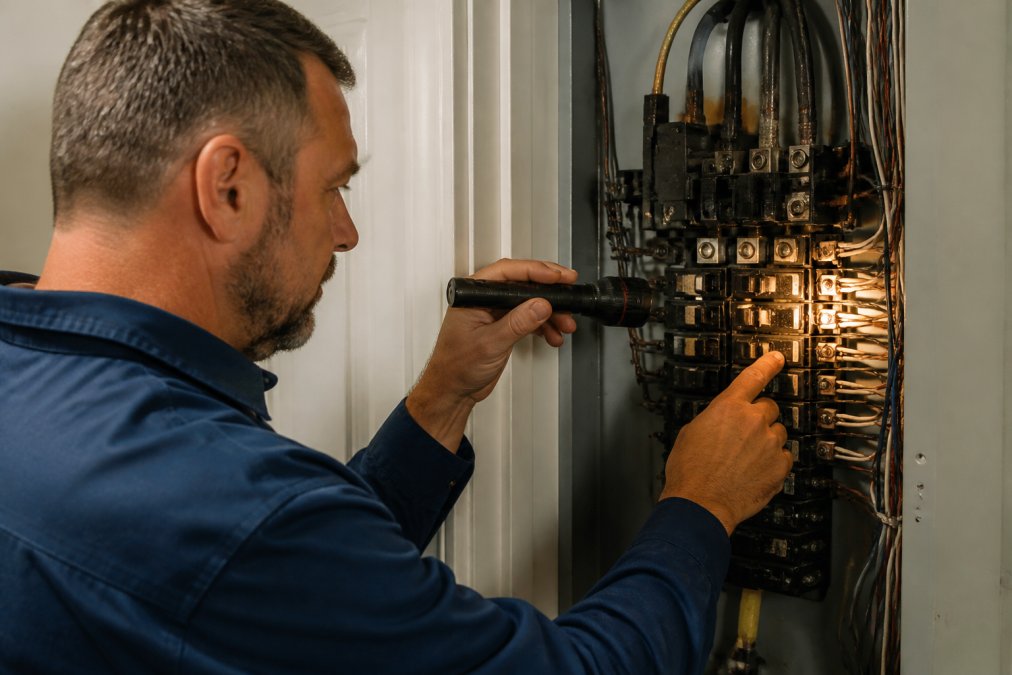
A breaker that looks fine can still be mechanically compromised. If it has tripped under fault conditions multiple times, its internal components may no longer respond accurately. A multimeter continuity test by a licensed electrician confirms whether the breaker functions within spec.
Never attempt to replace a circuit breaker yourself unless you are a licensed electrician. The service panel contains live conductors that remain energized even with the main breaker off. Contact is fatal.
How to Reset a Tripped Circuit Breaker Safely
Resetting a tripped circuit breaker is straightforward when the cause is a simple overload. Follow this process in order.
Before resetting, unplug devices from the affected circuit. Resetting into a live overload will trip the breaker again and can stress its internal components.
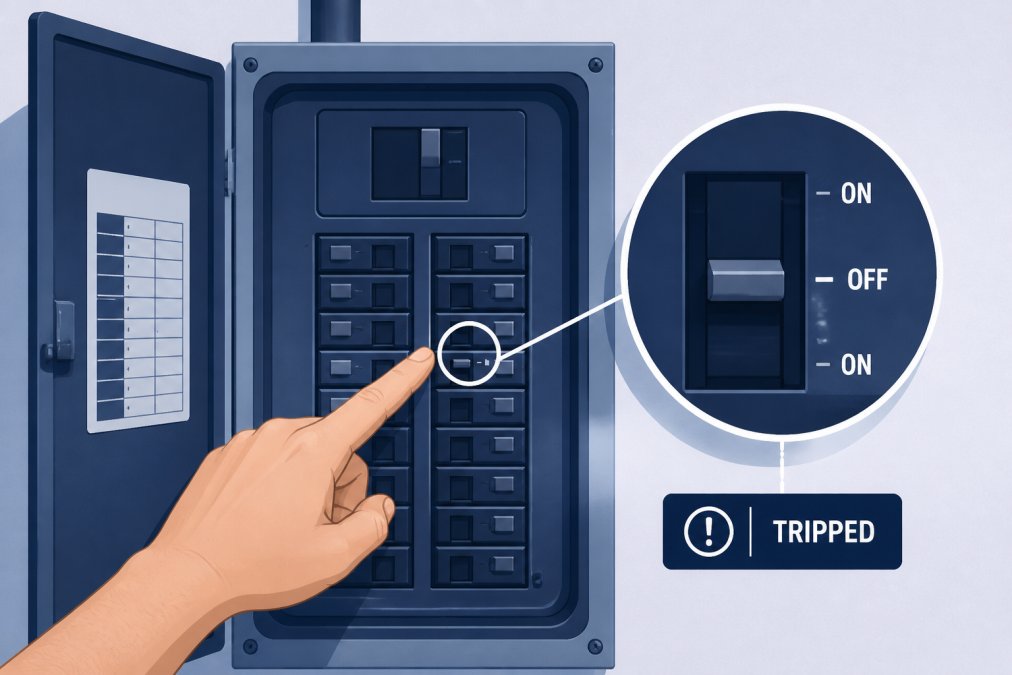
Step-by-Step Reset Process
-
Identify the tripped breaker. Open your electrical panel and look for the breaker in the middle position between ON and OFF.
-
Unplug all devices on that circuit. Go to the affected area and unplug everything before attempting a reset.
-
Turn the breaker fully to OFF. Push the toggle firmly to the OFF position first.
-
Wait 30 seconds. This allows the thermal trip element to cool and reset internally.
-
Push the toggle firmly to ON. You should feel a solid click.
-
Restore power to devices one at a time. Plug devices back in gradually to identify which appliance causes the overload.
-
If the breaker trips again immediately, stop. Do not attempt a second reset. A breaker that trips instantly with no load indicates a short circuit, ground fault, or failed breaker. Call a licensed electrician.
Label your panel. Spending 20 minutes labeling every circuit makes future troubleshooting significantly faster and safer, and helps an electrician work more efficiently.
AFCI and GFCI Breakers: Why They Trip More Often
Standard breakers respond to overloads and short circuits. AFCI and GFCI breakers detect hazards that standard breakers miss, which is why they trip more frequently, and why that’s correct behavior.
A GFCI breaker monitors the difference in current flow between hot and neutral conductors. If that difference exceeds about 5 milliamps, the breaker trips. This threshold protects against electrocution. GFCI protection is required by the National Electrical Code requirements for GFCI protection in bathrooms, kitchens, garages, outdoor circuits, and areas near water.
An AFCI breaker detects the electrical signature of an arc fault, dangerous sparking inside wiring or a device that can ignite surrounding materials without tripping a standard breaker. AFCI protection is required in bedrooms and most living areas.
Why they trip more than standard breakers:
- GFCI breakers trip from as little as 5 milliamps of leakage, far below standard breaker thresholds
- Aging appliance cords with minor insulation damage can trigger GFCI trips
- AFCI breakers can trip from certain motor-driven appliances that produce electrical noise resembling arc faults
- A GFCI or AFCI breaker tripping repeatedly signals a real fault, not a nuisance trip
If a GFCI breaker trips more than twice in a week on the same circuit, treat it as a diagnostic signal, not an inconvenience.
Electrical Panel Age, Capacity, and Smart Home Loads
Why circuit breakers keep tripping isn’t always about a single faulty device. Sometimes the problem is the panel itself.
Residential panels installed before the 1990s were designed around fundamentally different appliance loads. A typical home in the 1970s or 1980s drew a fraction of the electrical capacity modern homes require. Add EV chargers, smart home hubs, whole-home generators, high-draw kitchen appliances, and multiple home offices and you can exceed a panel’s total service capacity.
According to the U.S. Department of Energy’s residential energy use data, household electricity consumption has shifted significantly with electric vehicles and smart home technology, putting older 100-amp service panels under load conditions they weren’t engineered to handle.
Signs your panel capacity is the underlying issue:
- Multiple breakers trip regularly under normal household use
- You can’t run two high-draw appliances simultaneously
- The panel is 60-amp or 100-amp service in a home with modern demands
- The panel brand is flagged for known design defects
Smart home devices create persistent baseline loads that older branch circuits weren’t designed to carry continuously. A load calculation by a licensed electrician will identify whether your panel’s capacity matches actual usage.
A panel upgrade is a safety and functionality requirement for older homes with growing electrical demands. A licensed electrician can perform a load calculation and advise whether a service upgrade is necessary.
When Circuit Breakers Keep Tripping and You Need a Pro
Some situations are straightforward for homeowners: redistribute load, reset the breaker, done. Others require a licensed electrician.
Call a professional when:
- The breaker trips immediately after reset with nothing plugged in
- You smell burning plastic or see scorch marks near the panel or outlets
- The breaker feels hot or shows visible damage
- A GFCI or AFCI breaker trips repeatedly on the same circuit
- Multiple breakers trip under normal household use
- Your home has aluminum wiring from the 1960s or 1970s
- You’re adding high-draw appliances like an EV charger or hot tub
- The panel is more than 25-30 years old and hasn’t been inspected recently
The danger isn’t always the repair itself, it’s misdiagnosis. A homeowner who correctly identifies an overloaded circuit and redistributes load has done something useful. A homeowner who resets a breaker tripping from a ground fault in damaged wiring and assumes the problem is solved has created a fire hazard.
A panel inspection by a licensed electrician is far less expensive than emergency repairs. As documented in NFPA’s electrical fire safety statistics, many home electrical fires involve wiring and equipment that showed warning signs beforehand.
If you see burn marks, smell smoke, or hear buzzing or crackling from your electrical panel, do not reset any breakers. Turn off the main breaker if safe and call a licensed electrician immediately.
| Symptom | Likely Cause | Action |
|---|---|---|
| Breaker trips after adding appliances | Circuit overload | Redistribute load across circuits |
| Breaker trips instantly on reset | Short circuit or ground fault | Call a licensed electrician |
| Breaker trips in bathroom or kitchen | GFCI fault detected | Inspect appliances, call electrician if it repeats |
| Burning smell from panel | Arcing or overheating | Turn off main breaker, call electrician immediately |
| Multiple breakers tripping | Panel capacity issue | Schedule a load calculation and panel inspection |
| Breaker won’t stay reset | Failed breaker or wiring fault | Call a licensed electrician for breaker replacement |
Persistent breaker trips are your electrical system’s way of flagging a problem before it becomes a crisis. Hot Shot Electric Services Co. has over 30 years of experience diagnosing these situations, from straightforward overloaded circuits to complex panel upgrades for homes adding EV chargers or smart home systems. Our licensed and certified electricians serve homeowners and businesses across the area with fast response times and high-quality workmanship. Contact Hot Shot Electric Services Co. to schedule a panel inspection and get a clear answer on what’s causing your breaker to trip.
Frequently Asked Questions
Should I be worried if my breaker keeps tripping?
Yes, a breaker that trips repeatedly is telling you something is wrong. A single trip after plugging in too many appliances is normal, the safety switch did its job. But if the same breaker trips again after you reset it, or trips without an obvious cause, you likely have a circuit overload, a short circuit, a ground fault, or a failing breaker. Continuing to reset without finding the cause creates an electrical hazard. Have a licensed electrician diagnose it before the problem worsens.
How do I find out what keeps tripping my circuit breaker?
Start by checking the amperage of the circuit and adding up the wattage of every appliance on it. If the total load exceeds the breaker's rating, circuit overload is the cause. If the breaker trips immediately after resetting with nothing plugged in, a short circuit or faulty wiring is more likely. AFCI and GFCI breakers have test buttons, press them to confirm they function correctly. A multimeter can help check continuity, but persistent or unexplained tripping warrants a professional inspection of your electrical panel.
How many times can a breaker trip before it needs to be replaced?
There is no fixed number, but breakers are mechanical devices that wear out over time. Repeated thermal trips stress the internal components, and a breaker that no longer holds its reset position, feels loose, or trips under normal appliance loads has likely degraded. Breakers in panels older than 25-30 years are especially prone to failure. If your breaker won't reset or trips immediately after resetting, replacement is the safest course, do not force it or tape it in the on position.
When should I call a licensed electrician for a tripping breaker?
Call a licensed electrician if your breaker trips repeatedly after resetting, if you smell burning near the breaker box, if the breaker feels hot to the touch, if you see scorch marks or discoloration on the panel, or if the breaker won't stay reset. You should also call if your home has aluminum wiring, a panel older than 25 years, or if you've added significant new loads like an EV charger or smart home devices. These situations go beyond a simple reset and require a professional load calculation and panel inspection.
This article was written using GrandRanker