Table of Contents
- Why Commercial Power Outages Cost More Than You Think
- Electrical Infrastructure Audit: Your First Line of Defense
- Commercial Backup Generator Maintenance That Actually Works
- Uninterruptible Power Supply (UPS) for Business: Protecting Critical Equipment
- Cybersecurity, Insurance, and the Risks You Miss After Power Restoration
- Sustainable Energy Integration for Operational Resilience
- Business Power Outage Preparedness Checklist
- Conclusion
Last Updated: August 14, 2026
Why Commercial Power Outages Cost More Than You Think
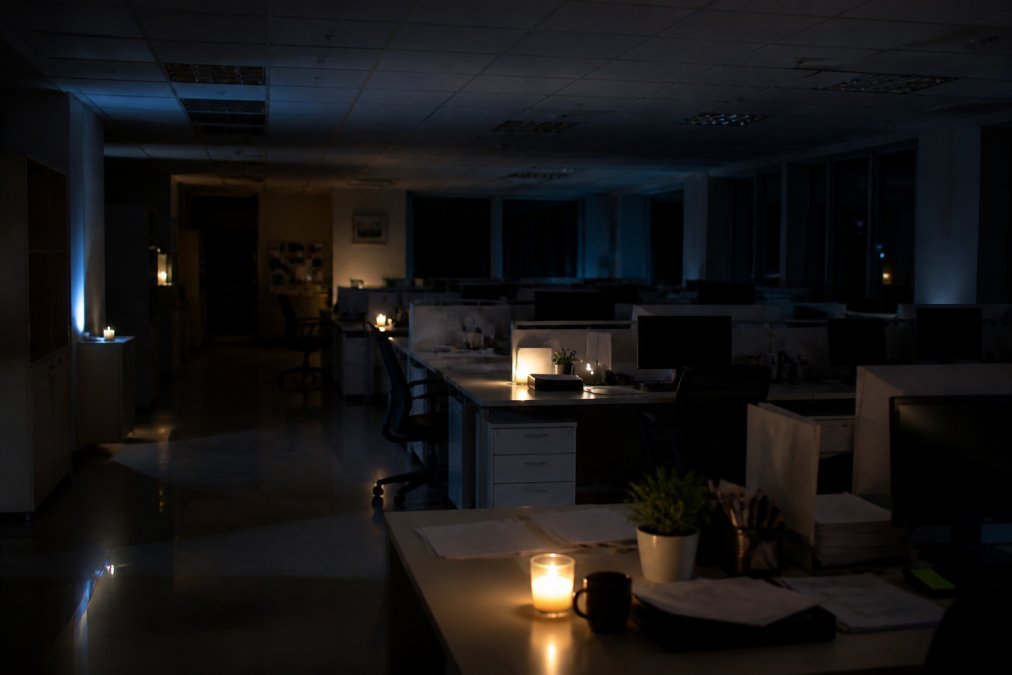
Commercial power outages are one of the most underestimated operational risks a business can face. Most people don’t think seriously about power reliability until they’re sitting in the dark with customers walking out the door.
The damage extends far beyond lost sales. Spoiled inventory, idle employees, corrupted data, missed deadlines, and equipment requiring recalibration after sudden shutdown all compound the immediate loss. For businesses running refrigeration, medical equipment, or continuous manufacturing, even a 15-minute failure can trigger cascading losses taking days to recover from.
Power outages also carry legal liability. If a customer is injured due to failed emergency lighting or unsafe conditions, the business owner bears responsibility. The Occupational Safety and Health Administration’s electrical safety standards require employers to maintain safe working conditions regardless of grid status. The real cost isn’t just immediate loss, it’s the compounding effect on customer trust, regulatory standing, and operational resilience.
Electrical Infrastructure Audit: Your First Line of Defense
Most commercial power outages originate inside the building, from aging wiring, overloaded circuits, deteriorating panels, and deferred maintenance. An electrical infrastructure audit identifies these failure points before they become emergencies.
A commercial electrical audit is a systematic inspection of a building’s entire electrical system, conducted by a licensed electrician, to identify code violations, capacity limitations, and components approaching end of life.
What a Commercial Electrical Audit Should Cover
A thorough audit should examine:
- Main service panel and subpanels for overheating, corrosion, outdated breakers, and capacity relative to current load
- Wiring condition for aluminum wiring in older buildings, insulation degradation, and improper connections
- Circuit load distribution to identify circuits running near or above rated capacity
- Grounding and bonding to protect against voltage fluctuations and surge damage
- Emergency lighting systems to confirm battery backup units are functional and meet code
- Surge protection devices for sensitive equipment
- Power factor and energy management to assess load management improvements
Older commercial buildings often have panels rated for loads that no longer reflect actual usage. If your building has added HVAC units, server equipment, or machinery since the last upgrade, your panel may be running closer to capacity than anyone realizes.
How Often to Schedule Preventative Maintenance
For most commercial facilities, a full electrical infrastructure audit should happen every three to five years. High-demand environments like restaurants, manufacturing, or data-heavy offices benefit from annual inspections. Preventative maintenance on individual components should happen at least once per year.
The National Fire Protection Association’s NFPA 70B standard for electrical equipment maintenance provides detailed guidance on recommended inspection intervals. Following those intervals creates a defensible record for insurance claims or regulatory inquiries.
Commercial Backup Generator Maintenance That Actually Works
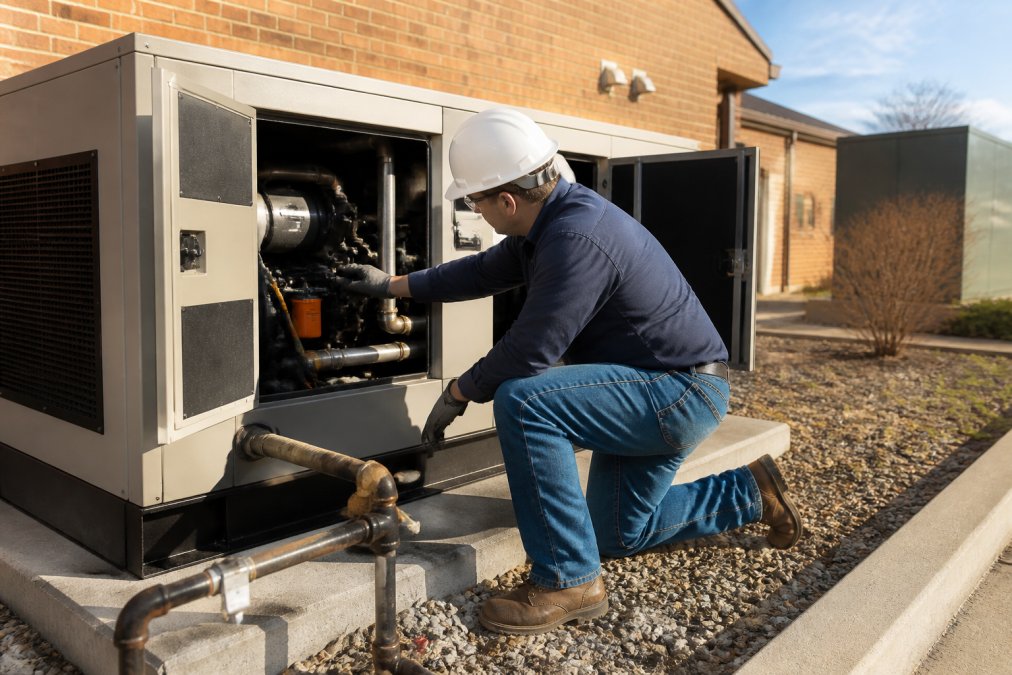
A standby generator is only as reliable as its last service date. Many businesses invest in backup power and then treat the generator like furniture, assuming it will work when needed. That assumption fails at the worst possible moment.
Commercial backup generator maintenance is the scheduled program of inspections, load testing, fuel management, and component replacement that keeps a generator ready to carry building loads during a grid outage.
Choosing the Right Generator Capacity
Undersized generators force manual load shedding decisions under pressure. To size a generator correctly, you need a complete load calculation accounting for:
- Continuous loads (HVAC, lighting, refrigeration, servers)
- Motor start loads, which draw significantly more power at startup
- Future load growth if expansion is planned
- Essential versus non-essential circuits for intentional load shedding
A licensed electrician should perform this calculation using actual metered data from your facility.
Load Shedding and Automatic Transfer Switches
An automatic transfer switch (ATS) detects utility power failure and automatically connects the generator to the building’s electrical system. Without an ATS, manual startup and switchover introduce delay and human error.
Load shedding strategically disconnects non-critical circuits during an outage to keep essential systems running within generator capacity, prioritizing emergency lighting, security, critical IT infrastructure, and equipment where sudden shutdown causes damage or safety risk.
Never connect a portable generator directly to a building’s electrical panel without a proper transfer switch. Backfeeding power into the utility grid is illegal under the [National Electrical Code (NEC) Article 702](https://www.nfpa.org/codes-and-standards/nfpa-70-standard-development/70) and can be fatal to utility workers.
Uninterruptible Power Supply (UPS) for Business: Protecting Critical Equipment
An uninterruptible power supply for business is a battery-backed power device providing immediate, seamless power to connected equipment the instant utility power fails. Unlike a generator, which takes seconds to start and transfer, a UPS bridges that gap with zero interruption, protecting servers, point-of-sale systems, medical devices, and equipment where momentary power loss causes data corruption or hardware damage.
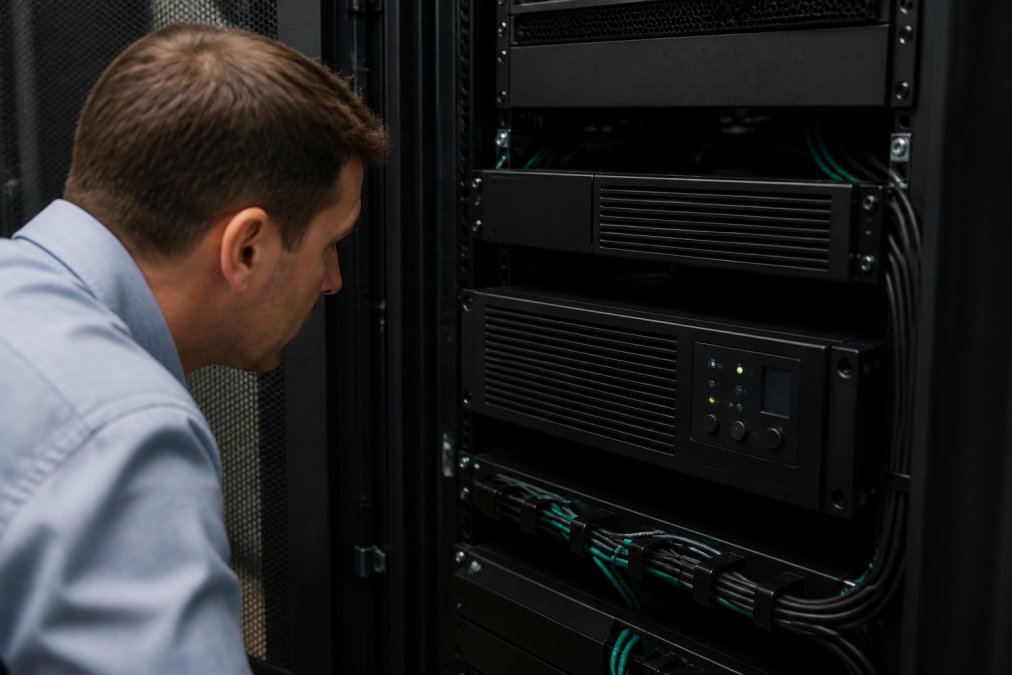
For most commercial applications, a UPS protects against complete power failures and conditions incoming power to smooth voltage fluctuations before they reach sensitive equipment.
Surge Protection and Voltage Fluctuation Defense
Power surges and voltage fluctuations cause far more cumulative equipment damage than full outages. A power surge is a brief voltage spike that can degrade or destroy electronics over time, even when equipment appears to function normally.
A layered surge protection strategy works best:
- Whole-building surge protection at the main service panel to catch large transient surges from lightning or utility switching
- Panel-level protection at subpanels serving sensitive equipment areas
- Point-of-use surge protectors at individual workstations, servers, and critical devices
| Protection Layer | Where Installed | What It Addresses |
|---|---|---|
| Whole-building SPD | Main service panel | Large external surges, lightning |
| Panel-level protection | Subpanels | Distributed surge events |
| Point-of-use devices | Individual equipment | Residual surges, local spikes |
| UPS with AVR | Critical equipment only | Voltage fluctuations, brief outages |
Cybersecurity, Insurance, and the Risks You Miss After Power Restoration
Power restoration carries its own set of risks. When power returns after an outage, systems reboot in an uncontrolled sequence. Network devices may come online before security software is fully loaded. Servers may restart with incomplete file system states. Businesses handling sensitive customer data, financial records, or protected health information should have a documented IT restart protocol verifying system integrity before resuming operations.
Many commercial property insurance policies include business interruption coverage, but triggers, waiting periods, and documentation requirements vary significantly. Review your policy to understand whether it covers outages caused by internal electrical failures, what documentation is needed for claims, and whether equipment damage from power surges is covered.
Regulatory compliance adds another layer for certain industries. Healthcare facilities under Centers for Medicare and Medicaid Services emergency preparedness requirements must maintain documented emergency power plans. Data centers and financial services firms face additional continuity requirements from their regulators. A power outage disrupting operations in a regulated environment may be a compliance event with reporting obligations.
Hidden costs of commercial power outages include cybersecurity exposure during system restoration, potential insurance claim denials due to policy gaps, and regulatory compliance failures in industries with mandatory continuity requirements.
Sustainable Energy Integration for Operational Resilience
Backup generators and UPS systems address outages reactively. Integrating renewable energy sources creates proactive operational resilience, reducing grid dependence and keeping critical systems running during extended utility failures.
Solar panels paired with battery storage are the most practical option for most commercial facilities. During normal operations, on-site solar generation reduces grid consumption and operating costs. During an outage, battery storage can power essential loads for hours or days. The U.S. Department of Energy’s guidance on distributed energy resources describes solar-plus-storage as a proven strategy for commercial energy resilience.
The practical integration path:
- Conduct an energy audit to identify base load and peak demand
- Size a solar array to offset meaningful daytime consumption
- Add battery storage sized to cover critical loads for a minimum of four hours
- Install a transfer switch allowing the solar-battery system to island from the grid during outages
- Connect to a monitoring platform providing real-time visibility into generation, storage, and consumption
Business Power Outage Preparedness Checklist
A business power outage preparedness checklist is a structured set of actions, equipment checks, and protocols ensuring a commercial facility can respond to and recover from power failure with minimal disruption.
Infrastructure and Equipment
- Main electrical panel inspected and serviced within the past 12 months
- Standby generator load-tested under full building load within the past 6 months
- Generator fuel supply checked and topped off
- Automatic transfer switch tested for correct operation
- UPS units tested and batteries replaced per manufacturer schedule
- Whole-building surge protection device inspected and confirmed functional
- Emergency lighting tested and battery backups verified
- Critical circuits identified and labeled on panel directory
Planning and Communication Protocols
- Emergency response plan documented and accessible to key personnel
- Contact list for utility provider, licensed electrician, and generator service company on file
- Communication protocols established for staff, customers, and suppliers during outage
- Data backup and redundancy verified (offsite or cloud backup confirmed current)
- IT restart protocol documented to address cybersecurity risks during power restoration
Insurance and Compliance
- Business interruption insurance policy reviewed for outage coverage terms
- Equipment damage coverage confirmed for surge and power failure events
- Regulatory compliance requirements documented (if applicable to your industry)
- Inspection and maintenance records retained for insurance and compliance purposes
Run a planned “outage simulation” once a year: transfer to generator power intentionally, verify all critical systems come up correctly, and identify gaps in your emergency response plan before a real outage forces the issue.
| Preparedness Area | Key Action | Frequency |
|---|---|---|
| Electrical audit | Full system inspection by licensed electrician | Every 1-3 years |
| Generator maintenance | Load test, fuel check, fluid inspection | Every 6 months |
| UPS battery check | Test runtime and replace aging batteries | Annually |
| Surge protection | Inspect whole-building SPD | Annually |
| Emergency lighting | Test battery backup function | Monthly |
| Data backup verification | Confirm offsite/cloud backup is current | Monthly |
| Insurance policy review | Confirm outage and surge coverage | Annually |
Preventing commercial power outages is fundamentally an infrastructure and planning discipline, not a crisis response one. Businesses that handle outages best have already invested in audited electrical systems, maintained backup power solutions, layered surge protection, and documented emergency response plans. Hot Shot Electric Services Co. brings over 30 years of experience and licensed, certified electricians to commercial electrical work, from panel upgrades and generator integration to full facility inspections. Contact Hot Shot Electric Services Co. today to schedule a commercial electrical audit and build the operational resilience your business depends on.
Frequently Asked Questions
What are the most common causes of commercial power outages?
The most common causes of commercial power outages include severe weather events like storms and ice, electrical grid failures, aging or overloaded wiring, equipment malfunctions, and power surges from nearby lightning strikes. Internal causes such as tripped breakers, faulty wiring, or overloaded circuits are also frequent culprits. Regular electrical infrastructure audits and preventative maintenance catch most of these issues before they cause costly downtime for your business operations.
How can businesses minimize the impact of a power outage?
Businesses can minimize the impact of commercial power outages by combining several layers of protection: a properly maintained backup generator with an automatic transfer switch, uninterruptible power supply (UPS) units for servers and critical equipment, surge protection on sensitive electronics, and a documented emergency response plan. A business power outage preparedness checklist ensures key personnel know their roles when the grid goes down, reducing recovery time significantly.
How often should commercial electrical systems be inspected to prevent outages?
Most commercial electrical systems should be professionally inspected at least once a year, though high-demand facilities or older buildings may need inspections every six months. A thorough electrical infrastructure audit checks panel condition, wiring integrity, load capacity, grounding, and surge protection devices. The National Fire Protection Association's NFPA 70B standard provides guidelines for commercial electrical maintenance schedules. Catching small issues early is far less expensive than emergency repairs after an outage.
What equipment is needed to prevent data loss during a blackout?
Preventing data loss during a commercial power outage requires a UPS (uninterruptible power supply) for servers and workstations, which provides immediate battery backup and allows for a safe system shutdown. Pair that with data redundancy practices such as cloud backups and off-site storage. Surge protection devices guard against voltage spikes during power restoration, which can corrupt drives. For extended outages, a backup generator keeps servers running until grid power returns.
This article was written using GrandRanker