
Table of Contents
- What You’ll Need Before You Wire Outdoor Kitchens
- NEC Requirements for Outdoor Kitchens
- GFCI Outlet Installation for Outdoor Kitchens
- Best Outdoor Electrical Conduit Types
- Step-by-Step: How to Wire Outdoor Kitchens Safely
- Smart Home Integration for Outdoor Kitchens
- Common Mistakes to Avoid and Troubleshooting Tips
- Conclusion
Last Updated: August 15, 2026
Outdoor kitchens are one of the most rewarding home improvements you can make, and one of the most unforgiving when the electrical work is done wrong. At Hot Shot Electric Services Co., we’ve seen firsthand what happens when homeowners skip permits, use indoor-rated materials, or underestimate circuit loads. The results range from tripped breakers to genuine fire hazards. This guide covers how to safely wire outdoor kitchens from start to finish, including NEC code references, GFCI requirements, conduit selection, and smart home integration that most guides ignore entirely.
The core challenge with outdoor kitchen wiring isn’t complexity, it’s that every component faces moisture, UV exposure, temperature swings, and insects that would destroy standard indoor electrical work. Get the materials and methods right, and your outdoor kitchen will run safely for years.
What You’ll Need Before You Wire Outdoor Kitchens
Before any wire gets pulled or conduit gets run, two things need to happen: a complete materials list and a permit. Skipping either one creates expensive problems after the fact.
Tools and Materials Checklist
Tools:
- Wire strippers, lineman’s pliers, and needle-nose pliers
- Fish tape or wire-pulling lubricant
- Conduit bender (for rigid metal conduit)
- Voltage tester and multimeter
- Drill with masonry and wood bits
- Trenching spade or mechanical trencher for underground runs
Materials:
- THWN-2 or UF-B wire rated for wet locations
- Schedule 40 or Schedule 80 PVC conduit, or rigid metal conduit (RMC)
- Weatherproof junction boxes and outlet boxes rated for wet locations
- GFCI-protected receptacles (20-amp, weather-resistant)
- In-use weatherproof covers for all receptacles
- Outdoor-rated wire connectors and conduit fittings
- Direct burial cable (if running underground without conduit)
- Appropriate circuit breakers for your electrical panel
Permitting and Inspection Requirements
Most jurisdictions require an electrical permit before you wire outdoor kitchens. The permitting process typically works like this:
- Submit a wiring diagram and load calculation to your local building department
- Receive permit approval
- Complete rough-in wiring
- Schedule a rough-in inspection before covering any work
- Complete finish work and schedule final inspection
As documented in NFPA 70 National Electrical Code overview, electrical work that bypasses the inspection process creates liability issues for homeowners, particularly during property sales or insurance claims. Pull the permit, it protects you.
Never cover wiring or bury conduit before the rough-in inspection. Inspectors need to see the work, and uncovering it later costs far more time and money than waiting a few extra days.
NEC Requirements for Outdoor Kitchens
The National Electrical Code treats outdoor kitchen spaces as a distinct environment with specific requirements across multiple articles.
Key NEC Articles That Apply
NEC Article 210 covers branch circuits. Each high-draw appliance, refrigerator, built-in grill ignition, and lighting circuit should ideally be on a dedicated circuit. Receptacles serving countertop surfaces must be GFCI-protected per Article 210.8.
NEC Article 210.8(A) specifically requires GFCI protection for all 125-volt, 15- and 20-amp receptacles installed in outdoor locations with no exceptions.
NEC Article 230 governs service entrance requirements if you’re adding a subpanel to serve the outdoor kitchen.
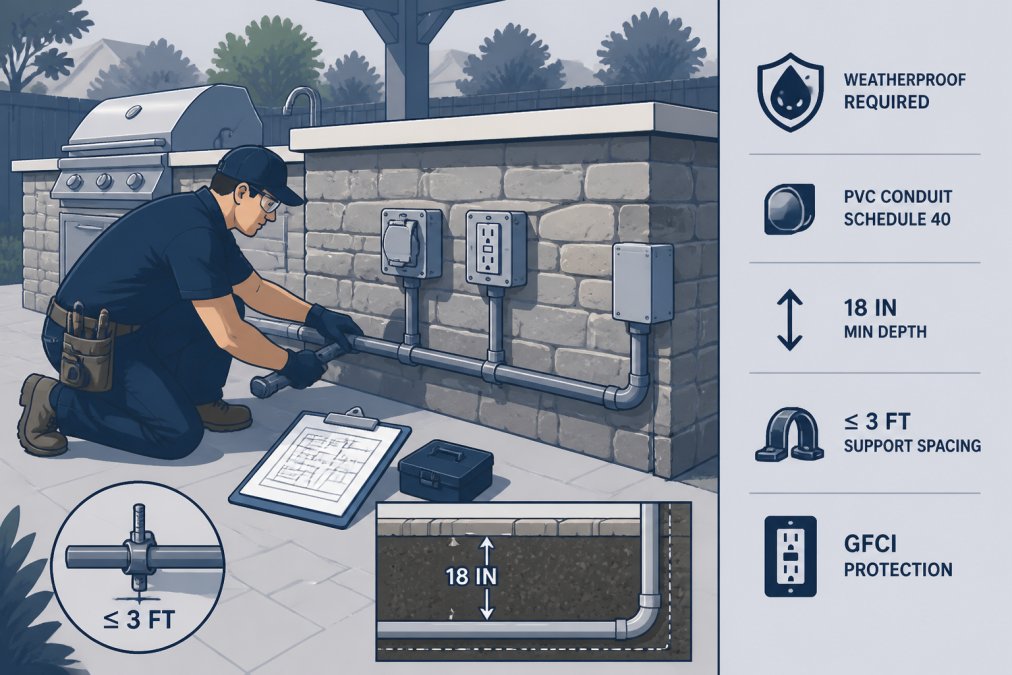
NEC Article 300 covers wiring methods, including conduit fill, burial depth, and protection from physical damage. For underground runs, the minimum burial depth for PVC conduit is 18 inches; for direct burial cable without conduit, the requirement is 24 inches.
NEC Article 406 covers receptacle requirements, including the mandate for weather-resistant receptacles in all outdoor locations.
According to National Electrical Code Article 210.8 GFCI requirements, GFCI protection is one of the most consistently enforced requirements during outdoor electrical inspections.
GFCI Outlet Installation for Outdoor Kitchens
GFCI outlet installation for outdoor kitchens is non-negotiable. A GFCI-protected receptacle monitors the difference in current between the hot and neutral wires. If it detects even a small imbalance caused by current leaking through a person or water, it trips in milliseconds.
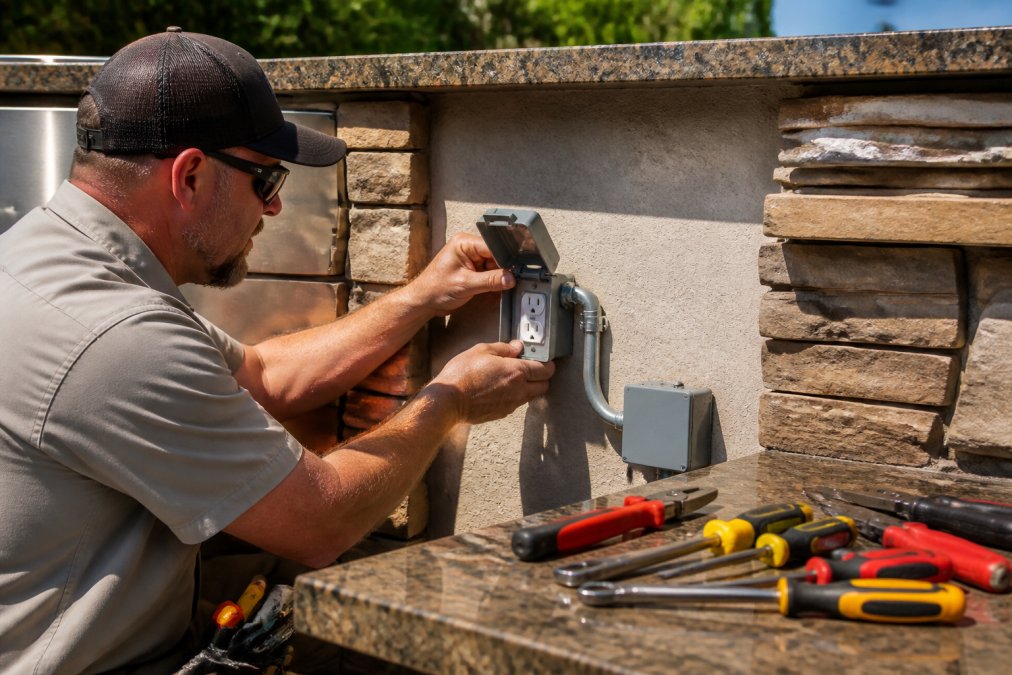
For outdoor kitchens specifically, here’s what proper GFCI installation looks like:
- Use 20-amp GFCI receptacles on kitchen circuits
- Mount receptacles in weatherproof outlet boxes rated for wet locations
- Install in-use covers that stay closed even with a cord plugged in
- Test GFCI function by pressing the "Test" button after installation; the outlet should go dead immediately
- Reset and verify the outlet restores power correctly
- Label the GFCI breaker or receptacle so future occupants know it exists
GFCI receptacles can be wired to protect downstream outlets on the same circuit. Wire the first outlet as a GFCI and run the remaining outlets off the "load" terminals. All downstream outlets gain GFCI protection.
Install GFCI receptacles at counter height (roughly 42 to 48 inches above the finished floor) to keep them accessible for resetting after a trip.
Best Outdoor Electrical Conduit Types
Choosing the right conduit is critical. Not all conduit is suitable for all outdoor conditions.
The best outdoor electrical conduit types for kitchen installations fall into three categories:
Schedule 40 PVC Conduit is the most common choice for underground runs. It’s corrosion-resistant, cost-effective, and approved for direct burial. Above ground, PVC is vulnerable to UV degradation and physical impact.
Schedule 80 PVC Conduit has thicker walls than Schedule 40 and is approved for above-grade exposed applications, providing protection against physical damage.
Rigid Metal Conduit (RMC) is the most durable option for above-grade exposed wiring. It’s approved for wet locations, provides excellent physical protection, and can serve as the grounding path for the circuit.
Liquidtight Flexible Metal Conduit (LFMC) is ideal for final connections to appliances and at junction points where rigid conduit can’t make the last few inches.
| Conduit Type | Best Use | Wet-Rated | Physical Protection |
|---|---|---|---|
| Schedule 40 PVC | Underground runs | Yes | Moderate |
| Schedule 80 PVC | Above-grade exposed | Yes | Good |
| Rigid Metal (RMC) | Exposed above-grade | Yes | Excellent |
| LFMC | Final appliance connections | Yes | Moderate |
A common mistake is using standard EMT (electrical metallic tubing) in outdoor wet locations. EMT is not approved for wet locations unless specifically listed for that use.
Step-by-Step: How to Wire Outdoor Kitchens Safely
The following sequence covers a complete outdoor kitchen wiring installation, from circuit planning through panel connection.
Step 1: Plan Your Circuit Load and Amperage
Circuit planning is the most important part of the project. Add up the amperage draw of every appliance and device the outdoor kitchen will run simultaneously. A built-in refrigerator, outdoor-rated lighting, and a few receptacles can easily push 40 to 60 amps of total load.
General guidelines for circuit allocation:
- Refrigerator: Dedicated 20-amp circuit
- Countertop receptacles: One or two 20-amp GFCI-protected circuits
- Lighting: Separate 15- or 20-amp circuit
- High-draw appliances (pizza oven, warming drawer): Dedicated circuits sized to the appliance nameplate
Voltage drop is a real concern for long runs from the main panel. For runs over 50 feet, upsize wire by one gauge to keep voltage drop within acceptable limits.
Step 2: Run Conduit and Pull Wire
Trench underground runs to the correct burial depth before pulling any wire. For PVC conduit, 18 inches of cover is the NEC minimum. Mark your trench route carefully to avoid irrigation lines and other utilities; call 811 before you dig to have underground utilities located.
Steps for pulling wire through conduit:
- Assemble all conduit sections and fittings before pulling wire
- Use fish tape or a pull string to thread through the conduit run
- Apply wire-pulling lubricant for runs over 25 feet
- Pull THWN-2 conductors (hot, neutral, ground) together
- Leave at least 6 inches of wire extending from each junction box and outlet box
- Secure conduit to structure at intervals per NEC requirements (typically every 3 feet for PVC, every 10 feet for RMC)
Direct burial cable (UF-B) can be used without conduit for underground runs, but it requires 24 inches of burial depth versus 18 inches for conduit-protected wire. Conduit also makes future wire replacement far easier.
Step 3: Install Weatherproof Receptacles and Covers
All receptacles in outdoor kitchen locations must be weather-resistant rated and installed in weatherproof boxes. The in-use cover must keep the receptacle protected even when a cord is plugged in.
Installation checklist for each receptacle location:
- Mount weatherproof outlet box flush with or proud of the finished surface
- Install weather-resistant GFCI receptacle (look for "WR" and "GFCI" markings on the face)
- Make connections: hot wire to brass screw, neutral wire to silver screw, ground wire to green screw
- For downstream GFCI protection, connect additional outlets to the "load" terminals
- Install in-use weatherproof cover and verify it seals correctly
- Test GFCI function before closing up the box
Step 4: Connect to the Electrical Panel and Test
Panel connections are where amateur work most often creates safety hazards. If you’re not confident working inside an energized panel, this is the step to hand off to a licensed electrician.
The connection sequence:
- Turn off the main breaker before adding any new circuit
- Install the new circuit breaker in an available slot
- Connect the hot wire to the breaker, neutral to the neutral bus, ground to the ground/neutral bus (in a main panel) or the ground bus (in a subpanel)
- Restore power and test each circuit with a multimeter before connecting any appliances
- Verify GFCI protection is functioning at all outdoor receptacles
- Label the new breakers clearly in the panel directory
According to Electrical Safety Foundation International (ESFI) home electrical safety resources, improper panel connections are a leading cause of electrical fires in residential properties. If there’s any uncertainty about panel work, bring in a licensed professional.
Smart Home Integration for Outdoor Kitchens
Smart home integration is one of the most practical upgrades you can build in during initial wiring. Adding it later is significantly more work.
The most useful smart integrations for outdoor kitchens include:
Smart Lighting Control: Install smart switches or dimmers on your outdoor kitchen lighting circuit for voice control, app-based scheduling, and automatic shutoff. Ensure any smart switch installed outdoors is rated for wet or damp locations.
Smart Outlets and Energy Monitoring: Smart outlets with energy monitoring let you track the load on each circuit from your phone, useful for identifying appliances drawing more power than expected.
Automated GFCI Monitoring: Some newer smart circuit breakers include ground fault protection with app notifications if a GFCI trips.
Landscape and Task Lighting Scenes: Smart lighting controllers allow you to create scenes, a bright task lighting mode for cooking, a dimmer ambient mode for dining, controlled from a single app or voice command.
The wiring infrastructure for all of these is identical to standard outdoor kitchen wiring. Plan your circuit layout with smart integration in mind: dedicated circuits for lighting make scene control cleaner, and a dedicated circuit for the refrigerator allows smart monitoring without interference from other loads.
Common Mistakes to Avoid and Troubleshooting Tips
The most common failures in outdoor kitchen electrical systems are shortcuts that seem fine at installation and become problems six to eighteen months later.
Using indoor-rated materials outdoors. Standard white receptacles, standard outlet boxes, and standard wire connectors are not rated for wet locations. Every component that touches the outdoor environment needs a wet-location or outdoor rating.
Skipping the dedicated grounding and bonding. Bonding connects all metallic components of the outdoor kitchen (appliances, gas lines, structural metal) to the electrical ground. Without proper bonding, a fault in one appliance can energize adjacent metal surfaces.
Relying on extension cords. Extension cords are not a permanent wiring solution. They’re not rated for continuous outdoor use, they create tripping hazards, and they’re a fire risk with high-draw appliances.
Undersizing circuits. A single 15-amp circuit for an entire outdoor kitchen is almost always inadequate. Plan for multiple circuits from the start.
Troubleshooting common failures:
| Common Problem | Likely Cause | Fix |
|---|---|---|
| GFCI trips repeatedly | Moisture intrusion in box or conduit | Inspect seals; replace in-use cover |
| Lights flicker under load | Voltage drop or undersized circuit | Upsize wire gauge or add dedicated circuit |
| Breaker trips at normal load | Circuit overloaded for continuous use | Redistribute loads; add circuits |
| Intermittent receptacle | Loose wire connection | Tighten or replace connections at outlet box |
| No power after rain | Water in junction box | Reseal box; upgrade to wet-rated enclosure |
For persistent issues, the right move is a professional diagnostic. As noted in CPSC electrical safety guidelines for homeowners, electrical faults that aren’t diagnosed correctly tend to get worse over time.
Never assume a tripping GFCI is a nuisance fault. A GFCI trips because it detected a ground fault, that’s the system working correctly. Investigate the cause before resetting and continuing to use the circuit.
Wiring an outdoor kitchen correctly requires more planning than most homeowners expect, and the consequences of cutting corners are real. Hot Shot Electric Services Co. has spent over 30 years handling exactly this kind of work, from circuit load planning and permit coordination to GFCI installation and panel connections. Our licensed and certified electricians know the NEC requirements, the local inspection process, and the materials that hold up in outdoor conditions year after year. If you want the job done right the first time, contact Hot Shot Electric Services Co. today.
Frequently Asked Questions
Does outdoor kitchen wiring require GFCI protection?
Yes. The NEC requires GFCI-protected receptacles for all outdoor kitchen outlets. Any receptacle installed outdoors must be on a GFCI-protected circuit, and wet or damp locations specifically require in-use weatherproof covers. This protection trips the circuit within milliseconds if a ground fault is detected, preventing electrocution near water sources like sinks and grills. Skipping GFCI protection will fail inspection and creates a serious safety hazard.
Is conduit mandatory for all outdoor kitchen electrical wiring?
Not always, but it is strongly recommended and often required depending on installation depth and location. Above-ground wiring exposed to physical damage must run through conduit. For underground runs, you can use direct burial cable like UF-B at the NEC-required depth, or run THWN wire through rigid PVC or IMC conduit at shallower depths. Conduit also makes future rewiring much easier. A licensed electrician can determine which method meets code for your specific setup.
What are the NEC requirements for outdoor kitchen outlets?
NEC Article 210 and Article 406 govern outdoor receptacle placement and protection. Outlets must be GFCI-protected, rated for wet or damp locations, and fitted with in-use covers. The 2-6-12 rule is a common reference: outlets should be no more than 2 feet above a countertop, within 6 feet of a sink, and spaced every 12 feet along countertop runs. Dedicated circuits are required for high-draw appliances like refrigerators and electric grills. Always verify requirements with your local authority having jurisdiction.
Can I use indoor-rated electrical components outdoors?
No. Indoor-rated receptacles, fixtures, and junction boxes are not sealed against moisture, insects, or temperature swings. Using them outdoors violates NEC code and will fail inspection. Outdoor kitchens require wet-rated or weather-resistant components throughout: weatherproof enclosures, outdoor-rated fixtures, GFCI-protected receptacles with in-use covers, and conduit or direct burial cable rated for exterior use. Using the wrong components creates shock and fire risks, especially near cooking equipment and water.
This article was written using GrandRanker